
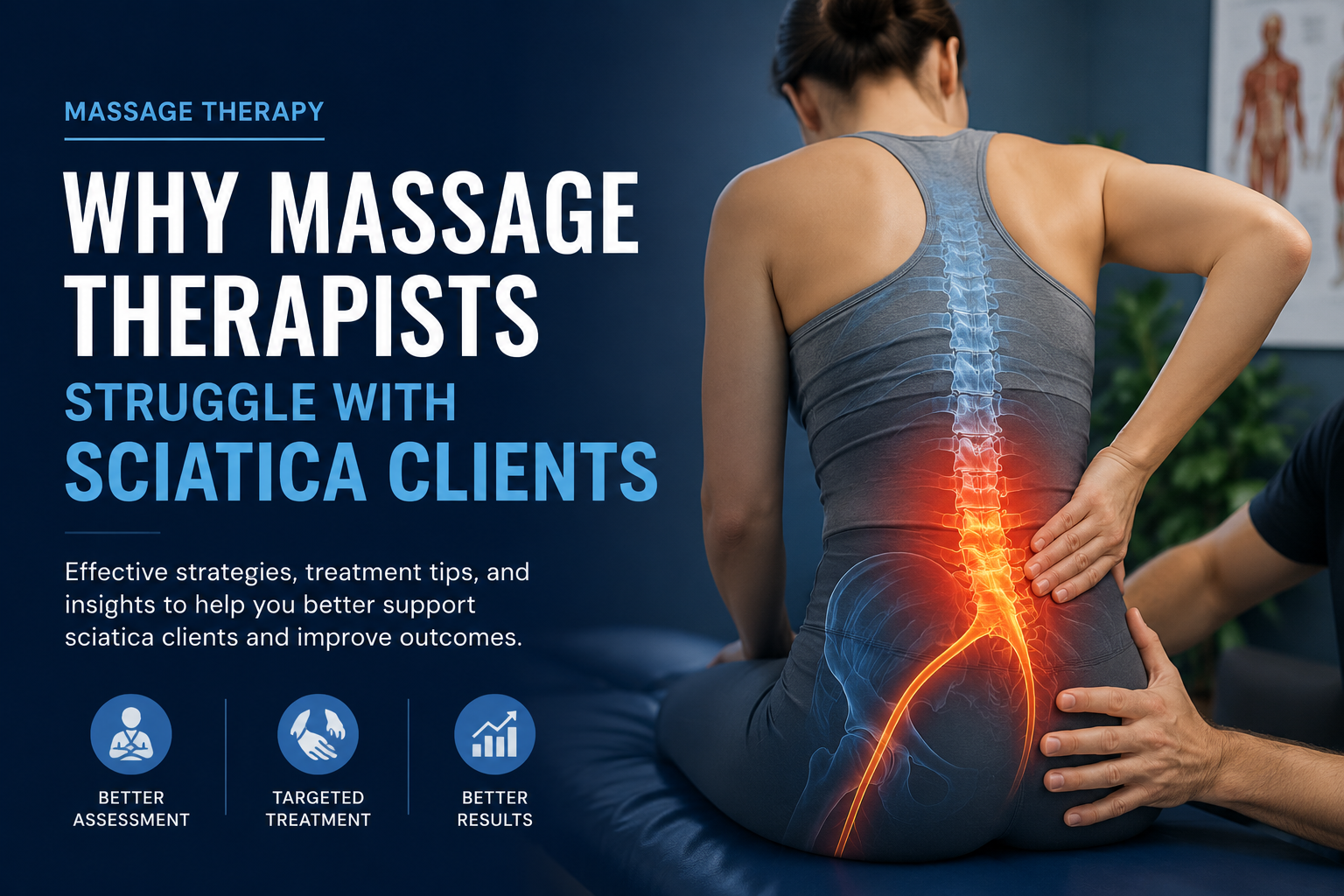

Many massage therapists approach sciatica by focusing only on where the client feels pain — often the glutes, hamstrings, or low back. But sciatic-type symptoms are frequently part of a larger protective pattern involving compensation, guarding, movement dysfunction, and altered mechanics. Understanding why the body is protecting can help therapists make better clinical decisions and avoid aggravating symptoms.
Sciatica Is Not Always Just a Pinched Nerve
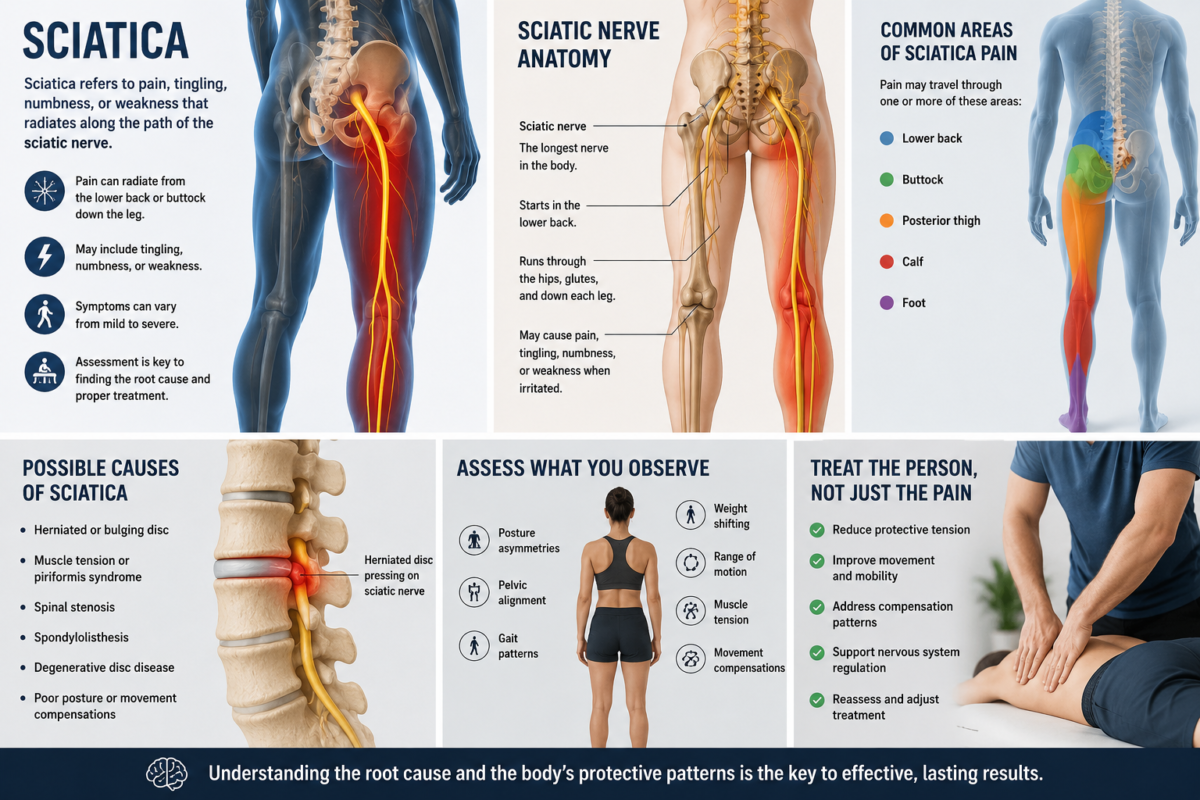
Sciatica is commonly described as irritation of the sciatic nerve, but not every case is caused by direct nerve compression. Symptoms can also be influenced by protective muscle guarding, pelvic mechanics, lumbar irritation, movement sensitivity, or neural tension. Some clients present with symptoms that behave mechanically and improve with movement changes, while others may demonstrate neurological signs that require caution or referral. Understanding this distinction is critical for safe and effective treatment.
Why Chasing the Pain Site Can Backfire
Many therapists instinctively apply deeper pressure directly into painful tissues, especially around the glutes or piriformis. However, aggressive pressure on an already irritated or guarded system can increase protective responses rather than reduce them. When the nervous system perceives instability or threat, it may increase tension, sensitivity, or guarding. Treating only the pain site without understanding the client’s overall compensation patterns may temporarily increase symptoms instead of improving function.
What Massage Therapists Should Observe First
Before treatment begins, therapists should observe how the client stands, walks, sits, and transfers weight. Gait patterns, pelvic shifts, asymmetrical loading, rib positioning, spinal mechanics, and breathing patterns can reveal why the nervous system may be protecting. Some clients consistently offload one side, avoid hip extension, lean into one leg, or demonstrate rotational compensations that contribute to ongoing irritation. Observation often provides more valuable information than simply chasing the area of pain.
Red Flags: When to Refer Out
Massage therapists must recognize when symptoms fall outside the normal presentation of mechanical or protective sciatica. Progressive weakness, bowel or bladder dysfunction, saddle numbness, unexplained severe neurological changes, or rapidly worsening symptoms require medical referral. Therapists should also be cautious when symptoms are highly irritable, non-mechanical, or not responding predictably to movement or positional changes. Clinical reasoning includes knowing when not to treat aggressively.
How Assessment-Driven Massage Helps
Assessment-driven massage focuses on reducing unnecessary protective tension while improving movement variability, breathing mechanics, and load distribution throughout the body. Instead of forcing tissues to relax, treatment aims to help the nervous system feel safer and less threatened. This may include positional work, gentle movement integration, breathing strategies, down-regulation techniques, and reassessment throughout the session. The goal is not simply pain relief, but improved function and reduced protective compensation.
Learn More in My Sciatica CEU Course
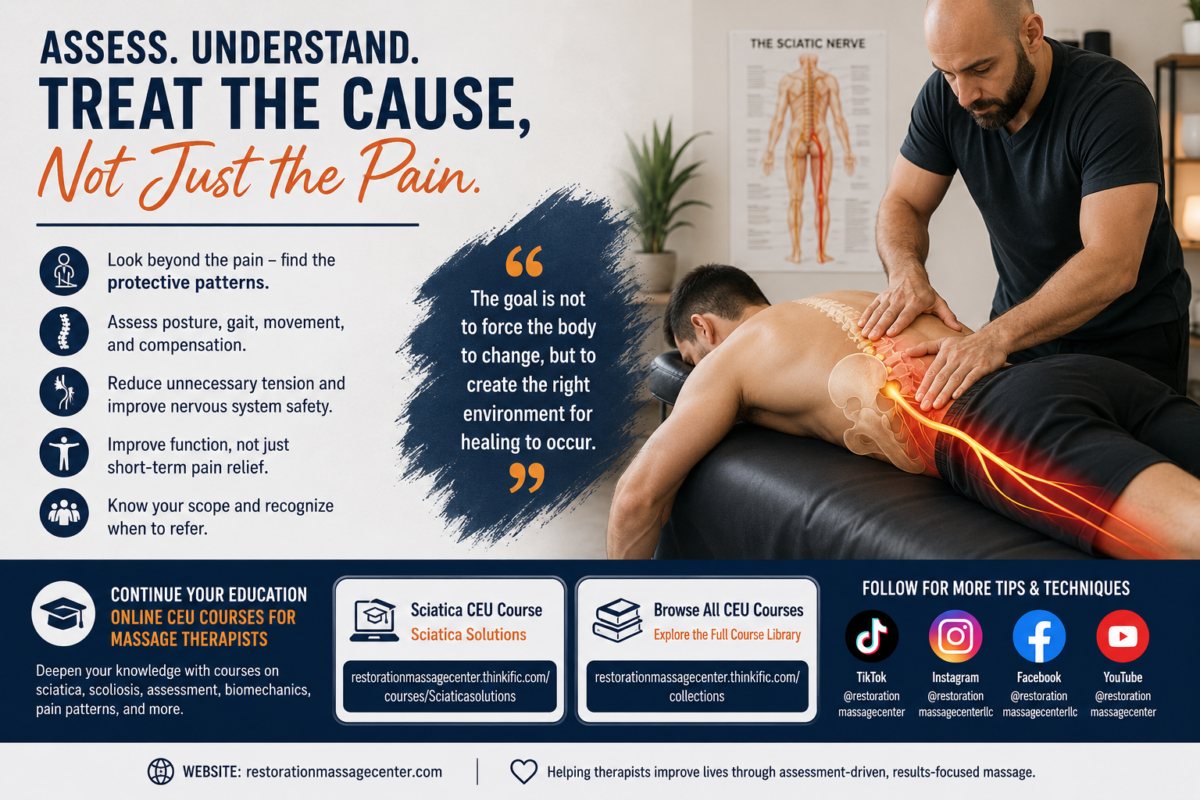
If you want a deeper clinical breakdown of sciatica, compensation patterns, assessment strategies, gait analysis, red flags, and treatment reasoning, explore my online Sciatica CEU course for massage therapists. This course focuses on understanding sciatica as a protective response rather than simply chasing symptoms, helping therapists build safer and more effective treatment strategies.
You can also explore additional online CEU courses covering scoliosis, for massage therapists inside the full course library.
Sciatica CEU Course:
Sciatica Solutions CEU Course
Browse All Online CEU Courses:
Restoration Massage Center CEU Collection
Follow for More Sciatica Tips & Techniques
For more sciatica education, massage therapy techniques, assessment strategies, posture analysis, and clinical reasoning content, follow my social media platforms where I regularly post educational videos, demonstrations, and therapist-focused content.
Website:
Restoration Massage Center Website
Online CEU Courses:
Browse All Massage CEU Courses
TikTok:
@restorationmassagecenter on TikTok
Instagram:
@restorationmassagecenterllc on Instagram
Facebook:
Restoration Massage Center Facebook Page
YouTube:
Restoration Massage Center YouTube Channel
Conclusion
Sciatica is often far more complex than simply treating pain running down the leg. For massage therapists, understanding protective patterns, movement compensations, posture, gait mechanics, breathing patterns, and nervous system responses can dramatically improve clinical reasoning and treatment outcomes. Instead of aggressively chasing symptoms, therapists should focus on understanding why the body is protecting in the first place.
Assessment-driven massage allows therapists to adapt treatment based on irritability, movement presentation, and the client’s overall functional patterns rather than relying solely on pain location. In many cases, improving movement variability, reducing protective tension, and addressing compensation patterns can create longer-lasting improvements than simply applying deeper pressure into painful tissues.
At the same time, recognizing red flags and knowing when referral is appropriate remains a critical part of responsible clinical practice. Effective treatment is not about forcing the body to change — it is about creating an environment where the nervous system feels safe enough to reduce unnecessary protection and restore better movement.
For massage therapists wanting to deepen their understanding of sciatica, assessment strategies, compensation patterns, and clinical reasoning, explore my online CEU courses and follow my educational content for more practical tips and demonstrations.
Written by Timothy Turnbow, Licensed Massage Therapist and Continuing Education Instructor at Restoration Massage Center.
Can massage therapy help sciatica?u003cbru003e
Massage therapy may help reduce protective tension, improve movement variability, decrease guarding, and improve overall comfort in some cases of sciatica. However, treatment should be based on assessment and clinical presentation rather than simply applying deep pressure to painful areas.
Is sciatica always caused by a pinched nerve?u003cbru003e
No. Sciatic-type symptoms can involve multiple factors including protective muscle guarding, neural irritation, movement dysfunction, compensation patterns, lumbar sensitivity, pelvic mechanics, or postural adaptations. Not all sciatic pain is caused by direct nerve compression.
Should massage therapists aggressively stretch clients with sciatica?
Not always. In some cases, aggressive stretching — especially of the hamstrings — may increase irritation if the nervous system is already highly protective or sensitive. Treatment should match the client’s irritability level and movement presentation.
What should massage therapists observe before treatment?u003cbru003e
Massage therapists should observe posture, gait, breathing mechanics, pelvic positioning, weight shifting, asymmetrical loading, spinal mechanics, and movement compensations before beginning treatment. These observations often reveal why the body may be protecting.
What are red flags massage therapists should watch for with sciatica?u003cbru003e
Red flags may include:u003cbru003eprogressive weaknessu003cbru003ebowel or bladder dysfunctionu003cbru003esaddle numbnessu003cbru003esevere neurological changesu003cbru003erapidly worsening symptomsu003cbru003eunexplained loss of coordinationu003cbru003eWhen these symptoms are present, referral to a medical provider is important.
Why can deep tissue massage sometimes worsen sciatica symptoms?
If the nervous system perceives excessive pressure as threatening, it may increase guarding and protective tension. Aggressive treatment applied to an already irritated system can sometimes increase symptoms rather than improve function.
Where can massage therapists learn more about sciatica assessment?
Massage therapists can explore my online Sciatica CEU course for deeper education on assessment strategies, compensation patterns, clinical reasoning, protective mechanisms, and treatment approaches.u003cbru003eu003cstrongu003eSciatica CEU Course:u003c/strongu003eu003cbru003eu003ca href=u0022https://restorationmassagecenter.thinkific.com/courses/Sciaticasolutionsu0022 target=u0022_blanku0022 data-type=u0022linku0022 data-id=u0022https://restorationmassagecenter.thinkific.com/courses/Sciaticasolutionsu0022 rel=u0022noreferrer noopeneru0022u003eSciatica Solutions CEU Courseu003c/au003e
Check Out My Sciatica Playlist On Youtube
Sciatica Playlist Click Here
https://youtu.be/3ukB0ZdKlkU?si=miUzp5PuM_s23VNU
I quite like reading a post that can make people think.
Also, thanks for allowing for me to comment!
Absolutely thanks
Heya i’m for the first time here. I came across this board and I
in finding It really helpful & it helped me out much.
I hope to provide one thing again and aid others like you aided me.
Thank you so much for your kind message! I’m really glad you found the information helpful and that it made a positive impact. That’s exactly why I enjoy creating this content. I truly appreciate you taking the time to comment, and I hope you continue to find value here in the future. Wishing you the best, and hopefully you’ll be able to help others as well!
I would like to thank you for the efforts you have put in writing this blog.
I’m hoping to check out the same high-grade content by you in the future as
well. In truth, your creative writing abilities has
motivated me to get my own website now 😉
Wow, thank you so much for the kind words! That truly means a lot to me. I’m really glad the blog has inspired and motivated you. Starting your own website is an exciting step, and I wish you the absolute best with it! I’ll definitely keep creating and sharing more high-quality content in the future. Thanks again for your support!
That’s great thanks
These are really enormous ideas in on the topic of blogging.
You have touched some good points here. Any way keep up wrinting.
Thank you so much! I truly appreciate the support and kind words. I’m glad you found the blogging tips helpful, and I’ll definitely keep sharing more content. Thanks again for taking the time to comment!
Thank you so much for your comment