


Shoulder Impingement & the Supraspinatus: Why Your Shoulder Keeps Getting Pinched
Understanding the real causes of shoulder impingement, supraspinatus irritation, compensation patterns, and where massage therapists often go wrong.
Shoulder impingement is one of the most common reasons people feel pain lifting the arm, reaching overhead, sleeping on one side, or performing repetitive upper-body activities.
One structure commonly involved is the supraspinatus tendon, part of the rotator cuff responsible for helping stabilize and lift the shoulder.
At Restoration Massage Center, I focus on assessment-driven therapeutic massage designed to help identify why the shoulder is becoming irritated instead of simply chasing pain.
What Is Shoulder Impingement?
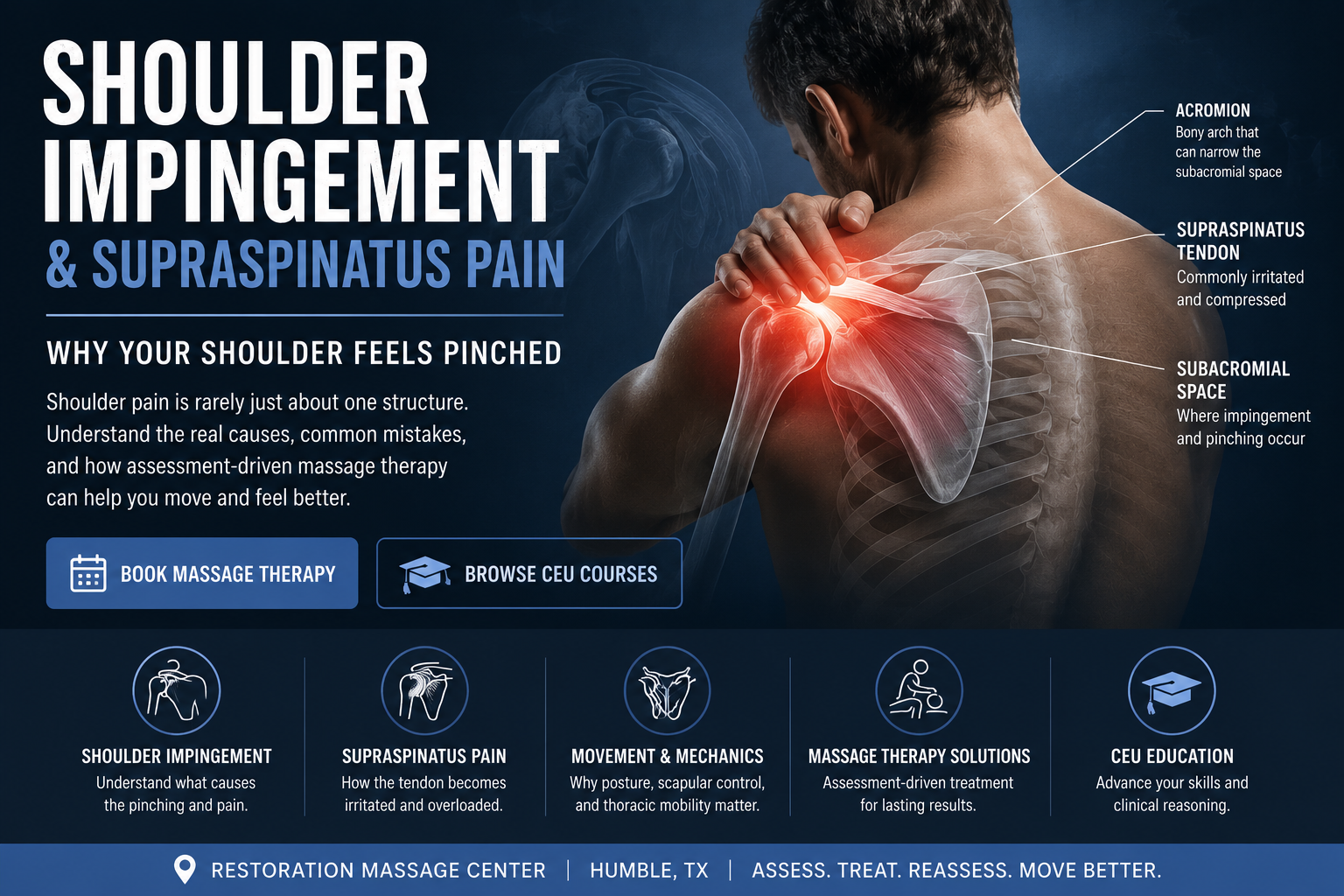
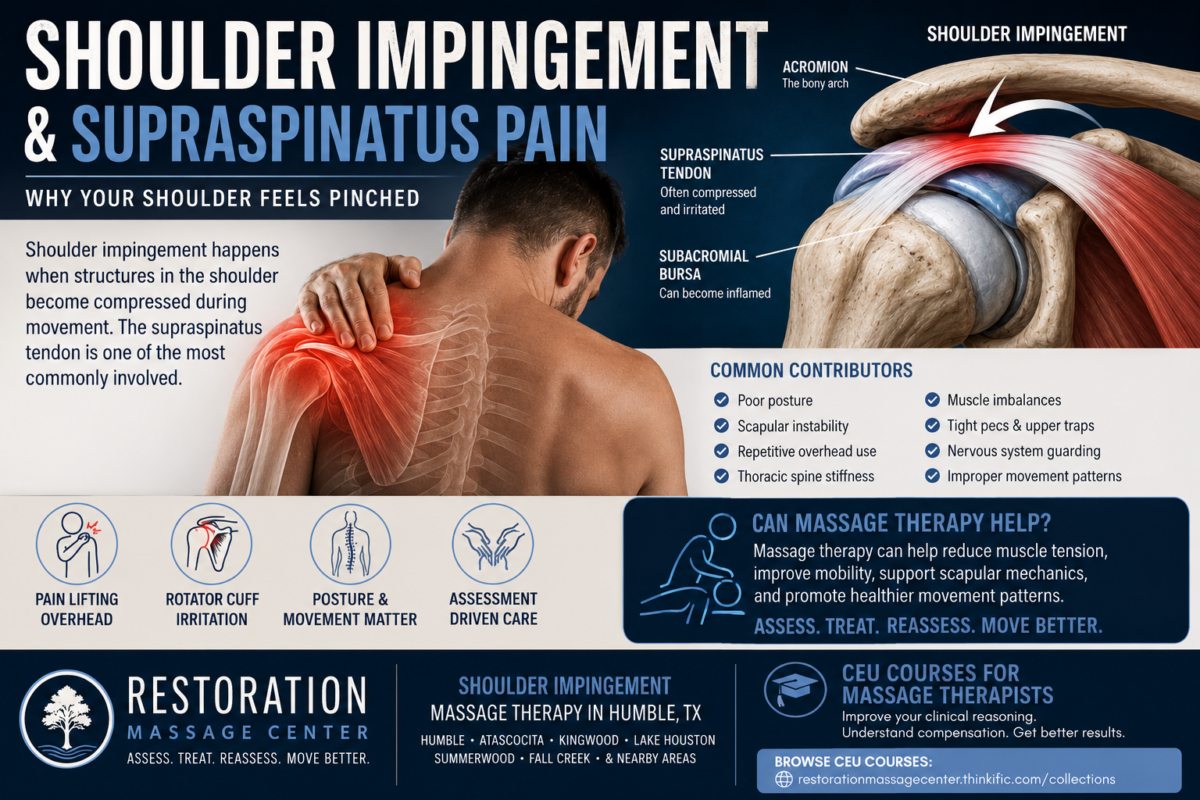
Shoulder impingement happens when structures inside the shoulder become compressed or “pinched” during movement.
The supraspinatus tendon runs underneath a bony arch called the acromion. When shoulder mechanics become altered, the space underneath that arch can narrow, increasing irritation and compression.
Over time, this may contribute to:
- Rotator cuff irritation
- Tendinitis
- Bursitis
- Weakness
- Painful overhead movement
- Protective guarding patterns
Many people describe symptoms like:
- Sharp pain lifting the arm
- Pinching sensations overhead
- Weakness reaching outward
- Pain sleeping on the shoulder
- Clicking or catching sensations
- Limited shoulder mobility
What Does the Supraspinatus Muscle Do?
The supraspinatus is one of the four rotator cuff muscles.
Its job is to:
- Help lift the arm
- Stabilize the shoulder joint
- Keep the humeral head centered during movement
When the shoulder loses efficient movement mechanics, the supraspinatus often becomes overloaded trying to stabilize the joint.
This is one reason many people experience recurring irritation even after temporary relief.
Why the Shoulder Starts Pinching
Many people assume shoulder pain starts only at the shoulder.
In reality, the body often creates compensation patterns involving:
- The shoulder blade
- Thoracic spine
- Rib cage
- Neck posture
- Upper back mechanics
- Breathing patterns
Common contributors include:
- Rounded shoulders
- Forward head posture
- Scapular instability
- Thoracic stiffness
- Poor overhead mechanics
- Repetitive lifting
- Muscle guarding
- Overactive upper traps
- Reduced rib cage mobility
When these patterns combine, the shoulder may gradually lose space during movement, increasing compression underneath the acromion.
Where Massage Therapists Often Go Wrong With Shoulder Impingement
One of the biggest mistakes therapists make with shoulder impingement is focusing only on the painful tissue instead of understanding why the shoulder is becoming compressed in the first place.
Many therapists immediately:
- Dig aggressively into the supraspinatus tendon
- Overwork the upper traps
- Stretch the shoulder aggressively
- Chase trigger points without reassessing movement
- Ignore scapular mechanics and rib positioning
- Assume “tight” always means “needs deeper pressure”
But shoulder impingement is often a mechanical and protective problem — not simply a muscle knot problem.
If the scapula lacks control, the thoracic spine is restricted, or the nervous system feels instability, the body may create guarding patterns around the rotator cuff to protect the joint.
This is why some clients feel temporary relief after massage, only for the pain to return quickly.
The Supraspinatus Is Often Overworking — Not Just “Tight”
The supraspinatus commonly becomes irritated because it is repeatedly trying to stabilize a shoulder that is not moving efficiently.
In many cases:
- The upper traps dominate movement
- The shoulder blade loses upward rotation
- The rib cage becomes stiff
- The thoracic spine stops extending well
- The humeral head glides improperly during arm movement
As this happens, the supraspinatus tendon may repeatedly get compressed underneath the acromion.
Aggressively smashing the tissue without improving mechanics may actually increase guarding and irritation.
Exercises That May Worsen Shoulder Impingement
- Upright rows
- Deep dips
- Aggressive overhead pressing
- Behind-the-neck presses
- Poorly controlled lateral raises
- Sleeping directly on the shoulder
My Clinical Approach to Shoulder Impingement
In my sessions, I focus on:
- Assessment before treatment
- Watching movement patterns
- Evaluating scapular control
- Reducing unnecessary guarding
- Improving thoracic and rib mobility
- Supporting healthier movement strategies
- Reassessing changes throughout the session
The goal is not simply making the shoulder “looser.”
The goal is helping the body move with less compression and better stability.
Protective guarding patterns are also common in sciatica presentations.
This same compensation-based approach is something I also discuss in my scoliosis education articles
Can Massage Therapy Help Shoulder Impingement?
Massage therapy may help support:
- Muscle relaxation
- Mobility
- Reduced protective tension
- Improved circulation
- Better movement awareness
- Healthier shoulder mechanics
Depending on your presentation, treatment may include:
- Trigger point therapy
- Myofascial techniques
- Rotator cuff work
- Thoracic mobility approaches
- Scapular stabilization strategies
- Pec and upper trap release
- Cupping therapy
- Movement-based reassessment
Every shoulder presentation is different, which is why reassessment matters.
When Shoulder Pain Needs Medical Attention
You should consult a healthcare provider if you experience:
- Sudden weakness
- Significant trauma
- Loss of shoulder function
- Numbness or tingling
- Severe night pain
- Suspected tearing
- Symptoms progressively worsening
Massage therapy is not a replacement for medical diagnosis or treatment.
Learn More in My CEU Courses for Massage Therapists
If you’re a massage therapist wanting to better understand compensation patterns, guarding, posture, and movement-based assessment, I also offer continuing education courses designed to improve clinical reasoning — not just memorizing techniques.
My CEU education focuses heavily on:
- Understanding protective patterns
- Assessment-driven massage
- Rib cage and spinal mechanics
- Why chasing pain often fails
- Scapular compensation strategies
- Nervous system guarding
- Movement-based reassessment
Browse all courses here:
Restoration Massage Center CEU Courses
You can also explore my scoliosis and sciatica education courses for massage therapists looking to improve their understanding of complex compensation patterns and chronic pain presentations.
Final Thoughts on Shoulder Impingement & Supraspinatus Pain
Shoulder impingement is rarely just about one irritated tendon.
In many cases, the body is adapting to poor mechanics, protective guarding, repetitive stress, posture changes, or instability patterns that gradually overload the supraspinatus and surrounding tissues.
This is why simply chasing pain with aggressive pressure or stretching often fails to create lasting results.
Real progress usually comes from:
- Understanding movement patterns
- Improving scapular control
- Reducing unnecessary guarding
- Supporting thoracic and rib mobility
- Reassessing how the shoulder functions as a whole
Whether you’re a client struggling with chronic shoulder pain or a massage therapist wanting to improve your clinical reasoning, learning to view the shoulder as part of a larger movement system can completely change treatment outcomes.
At Restoration Massage Center, my approach focuses on assessment-driven therapeutic massage designed to help the body move more efficiently — not just temporarily feel looser.
If you’re a massage therapist wanting to deepen your understanding of compensation patterns, guarding, posture, and movement-based assessment, be sure to explore my continuing education courses as well:
Check out my social media for amazing videos on this content.