
If you’ve ever experienced pain that starts in your hip or buttock and travels down your leg, you’ve probably heard someone say, “That’s sciatica.”
But what if it isn’t?
One of the most common mistakes I see is assuming every case of pain down the leg is sciatica. While true sciatica involves irritation of the sciatic nerve, piriformis syndrome can create very similar symptoms. Understanding the difference can help guide treatment and improve results.
What Is Sciatica?
Sciatica is a symptom, not a diagnosis.
It occurs when the sciatic nerve becomes irritated, compressed, or inflamed. This can happen for several reasons, including:
- Disc bulges or herniations
- Spinal stenosis
- Degenerative changes in the lower back
- Nerve root irritation
Common symptoms may include:
- Pain traveling down the leg
- Burning or tingling sensations
- Numbness
- Weakness in the leg or foot
- Symptoms that extend below the knee
What Is Piriformis Syndrome?
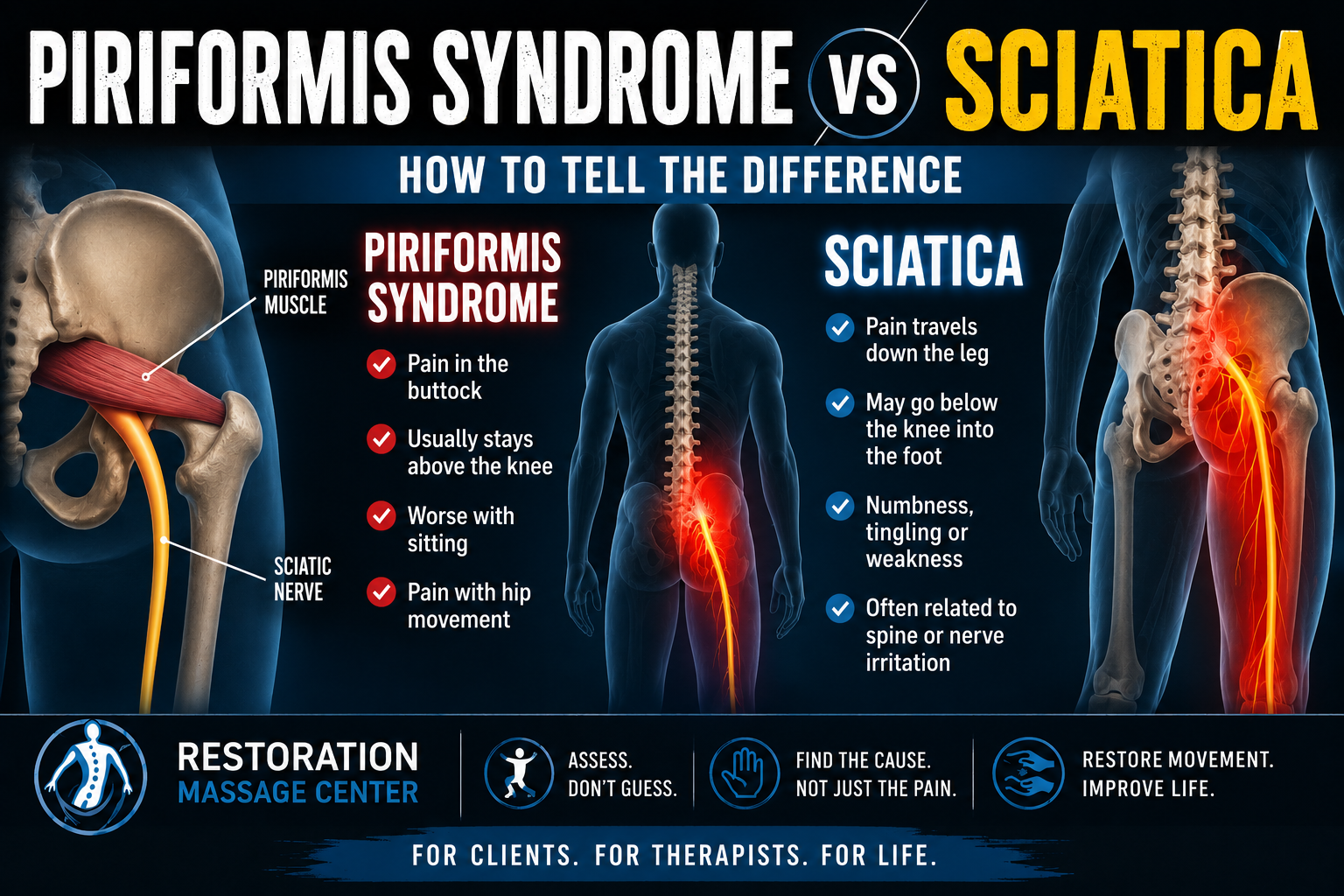
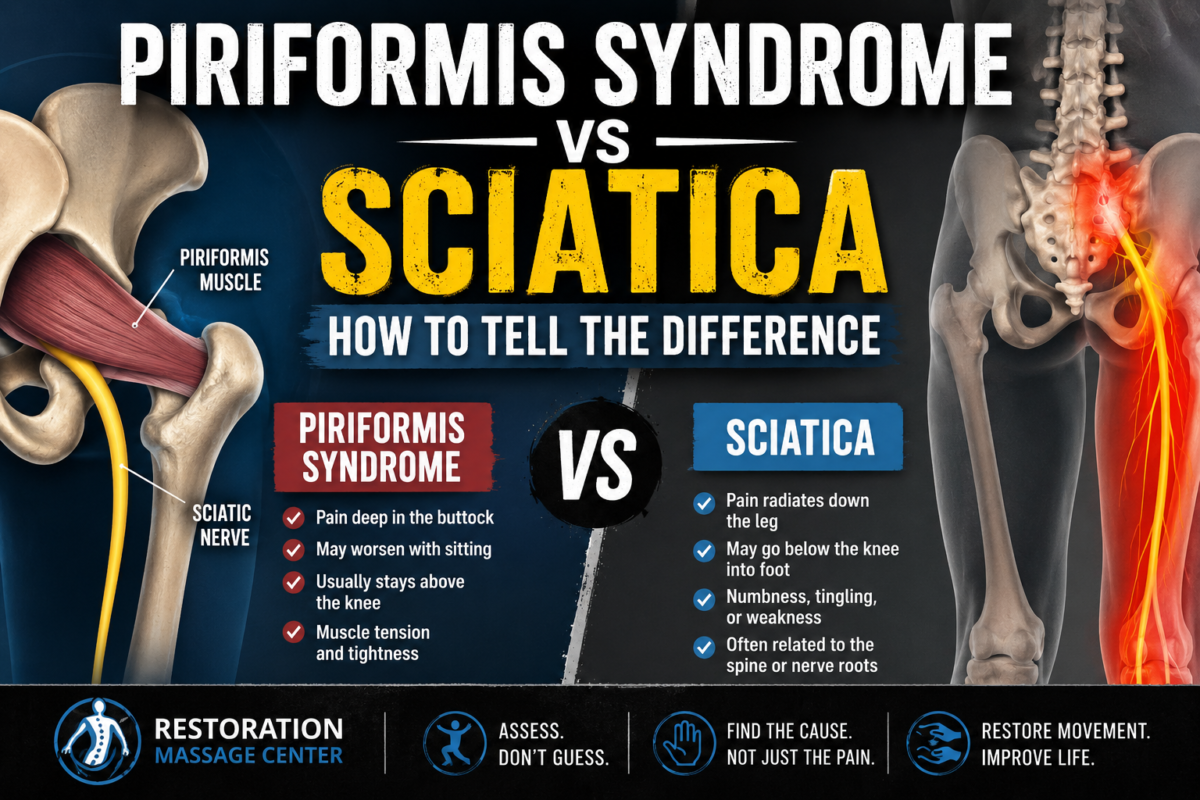
The piriformis is a small muscle located deep in the buttock.
Its job is to help rotate and stabilize the hip. In some individuals, irritation or increased tension around this muscle may contribute to compression or irritation of the sciatic nerve.
Common symptoms may include:
- Deep aching pain in the buttock
- Discomfort when sitting for long periods
- Pain with certain hip movements
- Symptoms that may travel into the back of the thigh
Because the symptoms can mimic sciatica, many people assume they have one when they may actually have the other.
Biggest Clues That Help Differentiate Piriformis Syndrome from Sciatica
While both conditions can cause pain into the leg, there are several clues that may point you in one direction or the other.
More Common with Piriformis Syndrome
✅ Pain is primarily in the buttock
✅ Symptoms often stay above the knee
✅ Sitting for long periods aggravates symptoms
✅ Tenderness directly over the piriformis muscle
✅ Pain may increase when crossing the legs or rotating the hip
✅ Symptoms often improve when standing or walking
More Common with Sciatica
✅ Pain frequently travels below the knee
✅ Numbness or tingling into the calf, foot, or toes
✅ Leg weakness may be present
✅ Coughing, sneezing, or bearing down can increase symptoms
✅ Symptoms may follow a specific nerve distribution
✅ Low back pain is often present alongside leg symptoms
The Biggest Giveaway
The single biggest clue is often how far the symptoms travel.
If symptoms consistently travel:
- Into the calf
- Into the foot
- Into the toes
The likelihood of true nerve involvement becomes much higher.
If symptoms remain:
- Primarily in the buttock
- Occasionally into the upper hamstring
- Rarely below the knee
The piriformis and surrounding hip structures become more suspect.
One Important Caveat
The body doesn’t always read the textbook.
I’ve seen clients with disc-related sciatica who had very little back pain, and I’ve seen clients with significant hip dysfunction create symptoms that mimic nerve pain.
This is why assessment should always be based on the entire presentation rather than a single symptom.
Why They Get Confused
Both conditions can create:
- Buttock pain
- Pain down the leg
- Sitting discomfort
- Difficulty with walking or exercise
The challenge is that the body often develops compensation patterns that make the source of the problem less obvious.
This is why assessment is important.
Looking Beyond the Pain
One of the biggest mistakes therapists and clients make is focusing only on where the pain is located.
Pain is often the body’s way of asking for protection.
Instead of asking:
“Where does it hurt?”
A better question is:
“What is the body trying to protect?”
When evaluating a client, I often look at:
- Weight shifting patterns
- Hip position
- Walking mechanics
- Single-leg balance
- Glute activation
- Lumbar and pelvic movement
These findings often reveal more than the pain itself.
When It May Be More Than Piriformis Syndrome
If symptoms include:
- Significant numbness
- Progressive weakness
- Foot drop
- Changes in bowel or bladder function
- Severe or worsening neurological symptoms
A medical evaluation should be considered.
How Massage Therapy May Help
Massage therapy may help reduce muscle tension, improve movement, and support overall function.
Treatment approaches may include:
- Gluteal muscle work
- Trigger point therapy
- Hip mobility strategies
- Lumbar and pelvic assessment
- Movement education
- Home exercise recommendations
However, successful treatment often involves addressing the entire movement pattern rather than focusing on a single muscle.
Not every pain in the buttock is piriformis syndrome.
Not every pain down the leg is sciatica.
The body is often more complex than that.
The goal isn’t simply to chase symptoms. The goal is to understand why the body is protecting in the first place.
By looking at movement, compensation patterns, and function, we can often develop a more effective treatment strategy.
What Therapies Work Best for Piriformis Syndrome and Sciatica?
One of the most common mistakes is treating every case of leg pain the same way. While piriformis syndrome and sciatica may feel similar, they often respond best to different treatment approaches.
Therapies Often Helpful for Piriformis Syndrome
When the piriformis muscle and surrounding hip tissues are contributing to symptoms, treatment may focus on reducing tension and improving hip function.
Common approaches include:
- Trigger point therapy to the gluteal muscles
- Deep tissue massage of the hip rotators
- Myofascial release around the hip and pelvis
- Glute strengthening exercises
- Hip mobility work
- Movement retraining
- Stretching when appropriate
The goal is not simply to “release the piriformis,” but to improve how the entire hip functions.
Therapies Often Helpful for Sciatica
When symptoms are coming from nerve irritation, treatment often requires a broader approach.
Depending on the cause, treatment may include:
- Massage therapy to reduce protective muscle guarding
- Gentle mobility exercises
- Nerve gliding (nerve flossing) techniques
- Core stabilization exercises
- Walking programs
- Physical therapy
- Chiropractic care when appropriate
- Medical evaluation if neurological symptoms are progressing
The objective is to improve movement and reduce stress on the irritated nerve while addressing the source of irritation.
When Strengthening Becomes Important
Many people focus entirely on stretching.
However, weakness is often part of the problem.
Areas commonly evaluated include:
- Gluteus medius
- Gluteus maximus
- Core stabilizers
- Hip rotators
- Single-leg balance and control
A muscle that is not functioning well may continue to create compensation patterns even after it has been stretched or massaged.
Why One Treatment Doesn’t Work for Everyone
Two people can have nearly identical symptoms but require completely different treatment strategies.
For example:
- One person may improve with hip-focused massage and glute strengthening.
- Another may need lumbar stabilization and nerve mobility work.
- A third may need referral for additional medical evaluation.
This is why assessment is often more important than the treatment itself.
My Approach at Restoration Massage Center
Rather than focusing only on where the pain is located, I evaluate:
- Posture
- Walking mechanics
- Weight-shifting patterns
- Hip function
- Core stability
- Compensation patterns
The goal is to identify what the body may be protecting and develop a treatment strategy based on the individual rather than simply treating the symptom.
Because whether it’s piriformis syndrome, sciatica, or a combination of both, understanding the “why” behind the pain is often the first step toward lasting improvement.
For Massage Therapists: Learn the Assessment Process Behind These Cases
If you’re a massage therapist, you’ve probably worked with clients who say they have “sciatica,” only to discover the presentation doesn’t quite fit what the textbooks describe.
Some clients improve quickly.
Others continue to experience recurring symptoms despite repeated treatment.
That’s where assessment and clinical reasoning become important.
Stop Chasing Symptoms
Many therapists are taught to focus on the area that hurts:
- Release the piriformis
- Stretch the hamstrings
- Work the low back
While these techniques may provide temporary relief, they don’t always explain why the body is protecting in the first place.
Questions I teach therapists to ask include:
- Is this truly nerve-related?
- What compensation patterns are present?
- How is the client walking?
- Can they load a single leg effectively?
- Are the glutes functioning properly?
- What is the body trying to protect?
Learn a Clinical Reasoning Approach
My continuing education courses focus on assessment-based treatment rather than memorizing protocols.
Instead of teaching therapists to chase symptoms, I teach them how to:
- Observe movement patterns
- Identify compensation strategies
- Recognize protective responses
- Improve clinical decision-making
- Develop more individualized treatment plans
Online Massage Therapy CEUs
Current courses include:
✅ Sciatica: Assessment & Clinical Reasoning
✅ Understanding Scoliosis Compensation Patterns
✅ Shoulder Impingement & Clinical Assessment
These courses are designed for massage therapists who want to think more critically, improve assessment skills, and gain confidence when working with complex pain presentations.
Learn More
Explore my online continuing education courses here:
Online Massage Therapy CEUs
👉 https://restorationmassagecenter.com/online-massage-therapy-ceus/
Whether you’re treating sciatica, scoliosis, shoulder pain, or chronic compensation patterns, the goal is the same:
Learn to identify why the body is protecting—not just where it hurts.
Follow Me on Social Media
Want more tips on sciatica, scoliosis, shoulder pain, assessment strategies, massage therapy techniques, and clinical reasoning?
Follow me for weekly content designed to help both clients and massage therapists better understand how the body moves, compensates, and protects.
Connect With Me
📱 TikTok: @restorationmassagecenter
📘 Facebook: Restoration Massage Center LLC
📸 Instagram: @restorationmassagecenter
🎥 YouTube: Restoration Massage Center
🧵 Threads: @restorationmassagecenterllc
📌 Pinterest: Restoration Massage Center
For Clients
Follow for:
- Pain relief tips
- Posture education
- Sciatica information
- Stretching and exercise ideas
- Self-care strategies
- Massage therapy insights
For Massage Therapists
Follow for:
- Assessment strategies
- Clinical reasoning
- CEU updates
- Case studies
- Treatment demonstrations
- Business and practice-building tips
Piriformis Syndrome and Sciatica Treatment in Humble, TX
If you’re experiencing buttock pain, hip pain, or symptoms traveling down the leg, a thorough assessment may help determine whether piriformis syndrome, sciatica, or another compensation pattern is contributing to your symptoms.
At Restoration Massage Center, I evaluate posture, movement, walking mechanics, and compensation patterns to develop an individualized treatment plan.
If you’re struggling with buttock pain, hip pain, or symptoms traveling down your leg, contact Restoration Massage Center to schedule an appointment.
📞 281-608-4425
📧 restorationmassagecenter@gmail.com
Learn More
🎓 Online Massage Therapy CEUs
Restoration Massage Center CEUs
🌐 Website
Restoration Massage Center
Whether you’re looking to move better, hurt less, or become a better therapist, I’d love to connect with you. Follow along and join the conversation.
Tim Turnbow, LMT
Restoration Massage Center
Serving Humble, Atascocita, Kingwood, Fall Creek, Eagle Springs, Summerwood, and the Lake Houston area.
📞 281-608-4425
📧 restorationmassagecenter@gmail.com
Related Reading:
- Sciatica Massage Therapy: Assessment & Clinical Reasoning
- Trigger Point Massage Therapy
- Deep Tissue Massage Therapy
- Cupping Massage Therapy
Ready to schedule? Contact Restoration Massage Center to learn more or book your next session.